
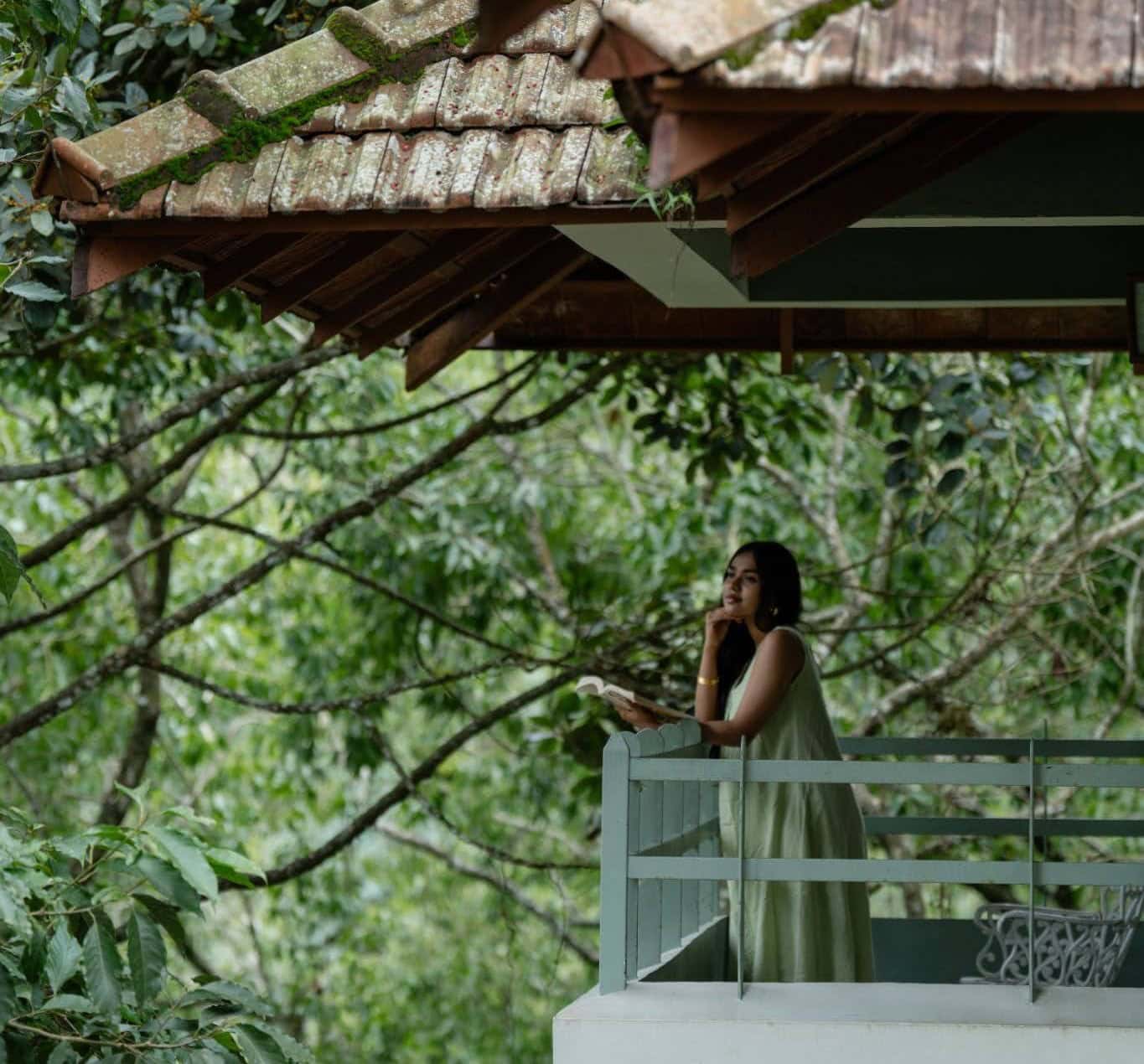
“Eco-friendly” is one of the easiest labels for a hotel to use and one of the hardest for a traveller to evaluate. A sustainable nature stay should be judged by what happens to the land, water, energy, waste and surrounding habitat, not simply by whether the property uses bamboo straws or has trees around the rooms.
At Blackberry Hills, sustainability began before hospitality. The land was purchased as an ecological restoration project, and the resort developed later as a way to sustain and share that work.
What should a sustainable stay in Munnar actually look like?
Restoration, not just landscaping
A landscaped garden can be beautiful without being ecologically meaningful. Restoration is different. It begins with damaged soil, habitat or vegetation and attempts to rebuild ecological function over time.
At Blackberry Hills, invasive species were progressively removed and native Shola vegetation was planted extensively. Foreign ornamental plants are still discouraged across the estate, while ferns have been deliberately nurtured on retaining walls and shaded surfaces.
Soil conservation suited to mountain terrain
Steep land requires careful erosion control, particularly in a high-rainfall environment. Blackberry Hills began using Vetiver extensively in 2004 as a biological soil-conservation system.
The deep-rooted grass was used around vulnerable slopes, pathways and farming areas. The work later developed into demonstrations of Vetiver-based slope management and Zero Risk Slope Farming.
Buildings that respond to the contours
The most obvious way to simplify a hill-resort project is to flatten land and concentrate rooms near the road. Blackberry Hills took a more difficult route: individual cottages were placed across the existing slope.
This required more construction effort but allowed the buildings to follow the terrain, preserve the character of the estate and take advantage of different valley perspectives.
The full architectural and restoration story is explained on Our Story.
Energy use
Solar power is used extensively across the property as part of the ongoing effort to reduce dependence on conventional energy sources.
No hotel can honestly claim that energy use has no environmental impact. The meaningful question is whether the property is actively reducing unnecessary consumption and shifting appropriate systems towards lower-impact sources.
Waste as part of a cycle
Blackberry Hills has long worked with composting, organic fertilising and related systems that return organic material to the land rather than treating all waste as something to remove from the property.
The estate’s broader approach has also included fish farming and experiments in linking food, soil and organic waste into a more circular system. Individual practices evolve, but the principle is to reduce waste and keep useful nutrients in circulation.
Biodiversity matters
A nature resort should make room for more than guests. Birds, frogs, moths, insects, squirrels and other wildlife are part of the Blackberry Hills estate.
Conservation work has included habitat support for the endangered Anaimalai Flying Frog, an initiative recognised with an ICRT Silver Award in 2022 for increasing tourism’s contribution to natural heritage and biodiversity.
Noise is an environmental issue too
Blackberry Hills deliberately avoids fireworks, loud parties and unnecessary amplified noise. This is not only about creating a peaceful guest experience. The estate is shared with wildlife, and constant disturbance is inconsistent with a nature-led property.
What sustainability does not mean
Sustainability does not mean pretending a resort has no footprint. Hospitality uses energy, water, materials and transport. Credible sustainability is about acknowledging those impacts and making better decisions over time.
It also does not require guests to sacrifice comfort. A resort can offer a spa, restaurant, infinity pool and well-appointed cottages while still making careful choices about how the land is managed.
How travellers can evaluate sustainability claims
- Ask what existed on the land before the resort.
- Look for specific conservation practices rather than generic “green” language.
- Check whether native habitat is protected or replaced by ornamental landscaping.
- Ask how waste and water are managed.
- Look at how buildings relate to the natural terrain.
- See whether the property supports local skills, culture or ecological knowledge.
- Be cautious of absolute claims such as “zero impact” or “100% sustainable.”
Sustainability as part of the guest experience
The original reason for opening Blackberry Hills to guests in 2002 was to share the restoration initiative rather than keep it hidden behind an estate boundary. Hospitality became a way to exchange ideas with travellers from around the world while continuing to finance ecological work.
That is why guided nature walks, birding, local culture, tea experiences and conversations about the estate belong naturally beside the more conventional parts of a resort stay.
Choosing a sustainable nature stay in Munnar
If sustainability is important to your trip, look beyond environmental claims on a booking page. Choose a property whose relationship with the land is visible in the way it is built, planted and operated.
Read the Blackberry Hills restoration story or explore the current stays.