

Blackberry Hills Journal · Offbeat Munnar & Kerala Culture
Tholpavakoothu: An Offbeat Cultural Experience in Munnar
Looking for unusual things to do in Munnar? Step beyond tea estates and viewpoints to discover Kerala’s living shadow puppetry tradition with the Pulavar artists at Blackberry Hills.
Blackberry Hills Editorial Team · October 2026
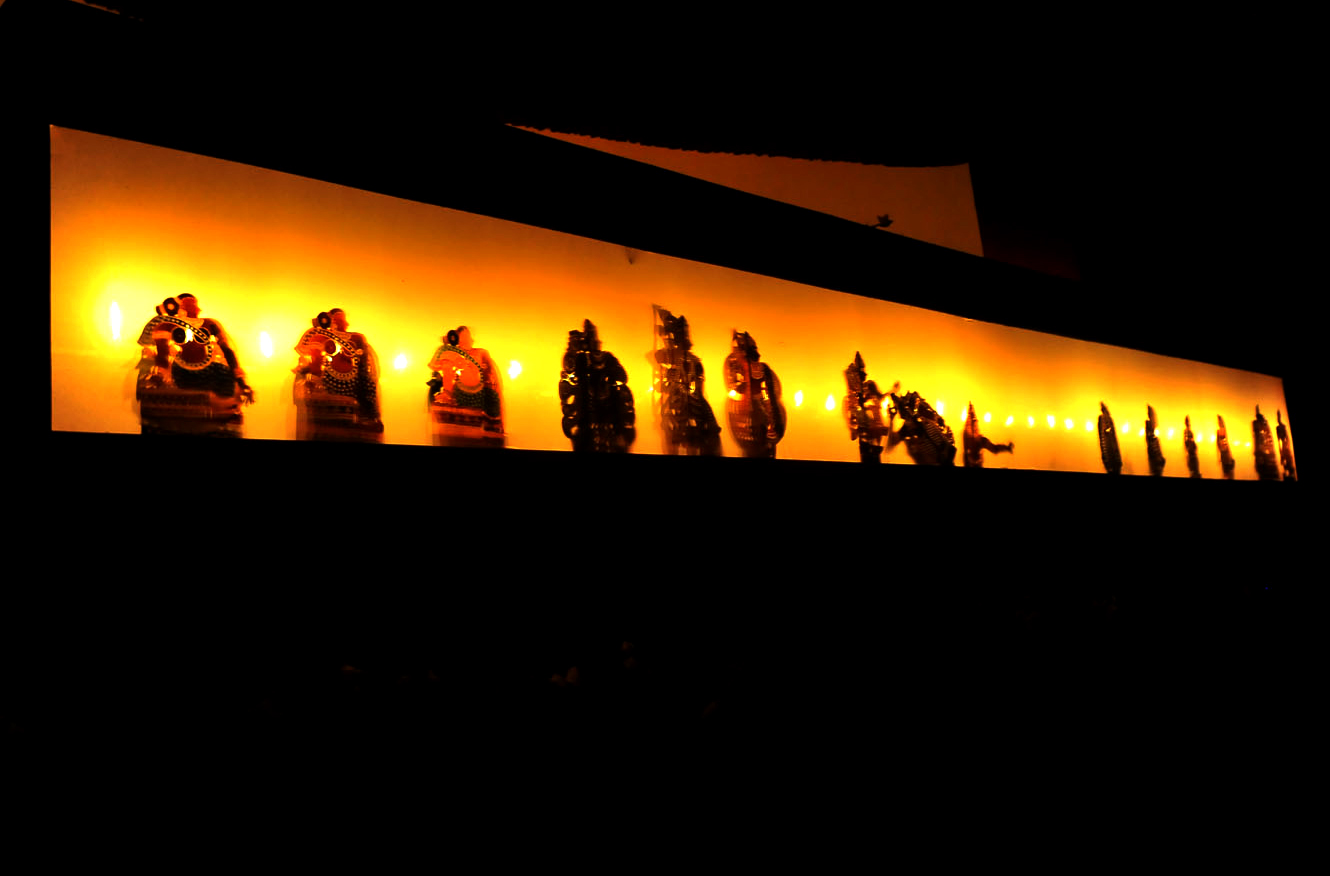
There is a moment in Tholpavakoothu when a plain screen begins to feel like a world of its own. Lamps glow behind it. A voice introduces a story. Then figures cut from leather appear as moving shadows, their elaborate shapes coming alive through the work of artists the audience cannot see.
This is Tholpavakoothu, Kerala’s traditional shadow puppet theatre. Rooted in the Bhagavathy temple traditions of Palakkad and Malabar, it brings together craft, recitation, music and storytelling. Today, artists also introduce the tradition through demonstrations and workshops beyond its original ritual setting.
At Blackberry Hills Munnar Nature Resort & Spa, our partnership with Vipin Viswanatha Pulavar creates opportunities for guests to encounter this remarkable art form. We host performances and learning sessions from time to time and can explore arrangements on request.
What is Tholpavakoothu?
The name describes what you see: thol means leather, pava is a puppet, and koothu refers to performance. Puppets are shaped from leather, cut into intricate figures and moved behind a cloth screen. A source of light produces their silhouettes, while the performers give them voices, gestures and stories.
The traditional repertoire draws heavily on the Kamba Ramayanam, the Tamil rendition of the Ramayana by the poet Kambar. The artists must be skilled not only in puppet manipulation but also in literature, memory, vocal expression and the rhythm of live performance.
For someone watching it for the first time, its appeal is immediate: a small movement of a hand becomes an expressive character; a change in position alters the shadow; a familiar story acquires an entirely different visual language.
Why is Tholpavakoothu performed in temples?
The traditional setting is a koothumadam, a theatre associated with a temple dedicated to Goddess Bhadrakali. A full ritual presentation can unfold over many nights, with episodes of the epic performed in a prescribed sequence.
One legend associated with the tradition says Bhadrakali was engaged in battle with the demon Darika and therefore did not witness Rama’s victory over Ravana. The performance of the Ramayana in her presence offers her the opportunity to experience that story. It is a meaningful part of the tradition’s sacred narrative, not a claim that can be historically verified.
Although contemporary audiences may encounter a shorter stage presentation, the temple setting remains central to understanding the art. A workshop is an introduction to its techniques. A ritual performance belongs to a wider calendar of community practice, worship and cultural memory.
The craft behind the screen
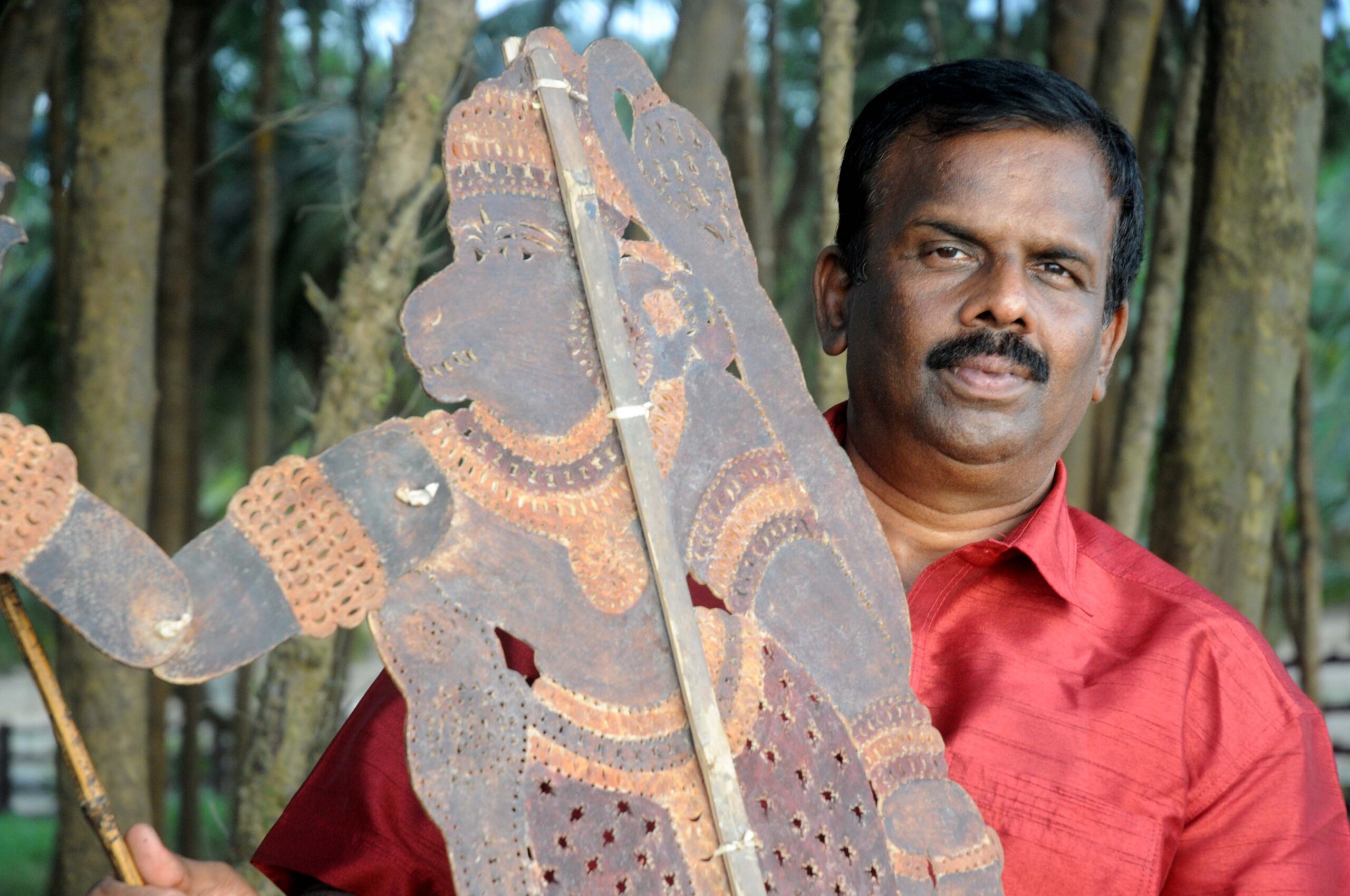
Look at a finished puppet in daylight and the detail is astonishing. Its outline is carefully cut; tiny openings create ornament and texture; the joints and rods determine how a character can move. The puppeteer has to think about what the audience will see as a shadow, not only what the figure looks like in the hand.
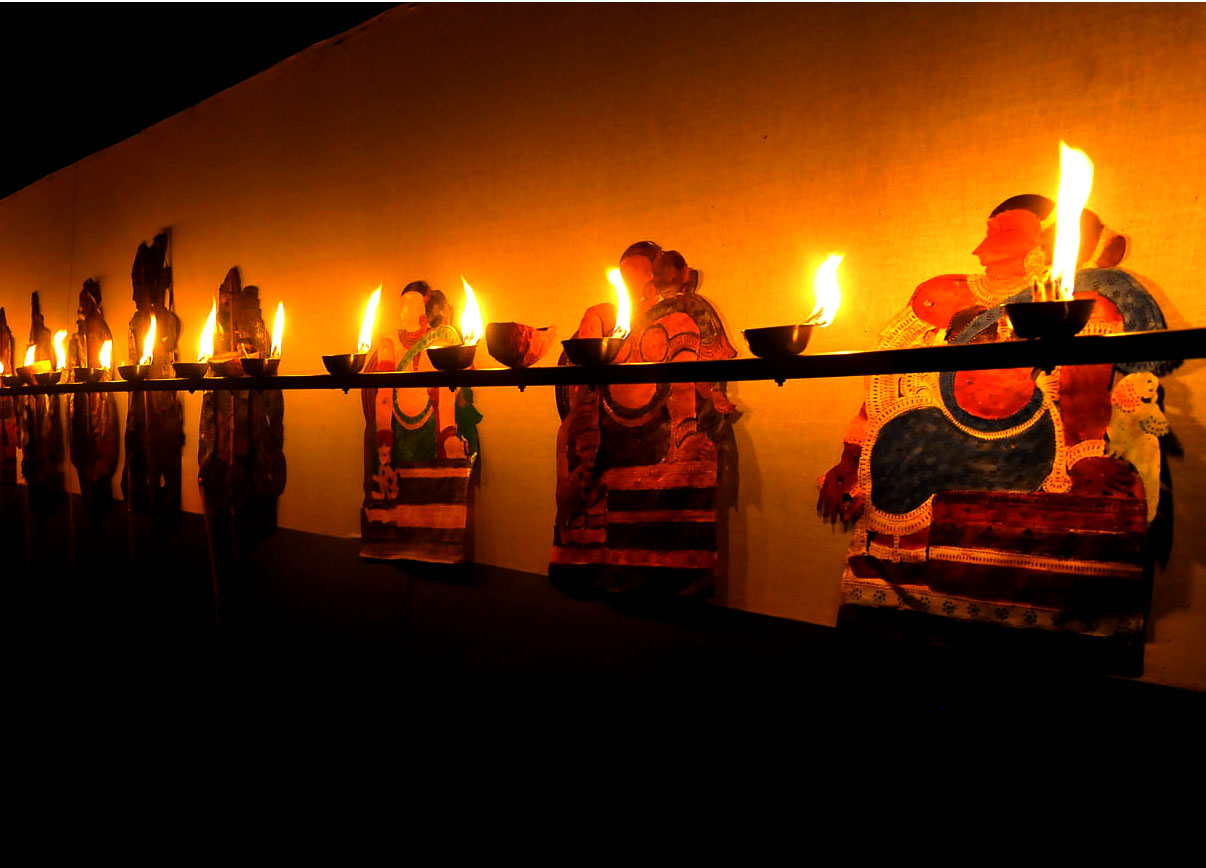
Lighting is part of the performance. Traditionally, oil lamps shine from behind the puppets. By changing the puppet’s angle and distance from the light and screen, artists can alter how its shape appears. The movement must work alongside narration and music, often with several artists working in coordination.
That is why the tradition cannot be passed on through a written script alone. Someone must learn to cut, hold, move, speak, listen and respond. The skills are interconnected.
Vipin Viswanatha Pulavar: carrying the tradition forward
Vipin Viswanatha Pulavar was born in 1992 into a family associated with Tholpavakoothu in Koonathara, Palakkad. His father, K. Viswanatha Pulavar, was also his teacher. Vipin’s professional biography describes learning the manipulation of puppets, puppet-making, the recitation of verses and the development of new productions.
His work has included performances, teaching, demonstrations and workshops for students and audiences in India and abroad. His biography records participation in puppet festivals in Thailand, China, South Korea and Singapore, as well as longstanding involvement in the family’s Tholpavakoothu practice.
Recognition at the national level
On 19 October 2026, Vipin received the Ustad Bismillah Khan Yuva Puraskar, a national recognition instituted by the Sangeet Natak Akademi for outstanding younger performing artists. He was recognised in the puppetry category for Kerala. The award was presented in New Delhi by Union Minister for Culture and Tourism Shri Gajendra Singh Shekhawat.
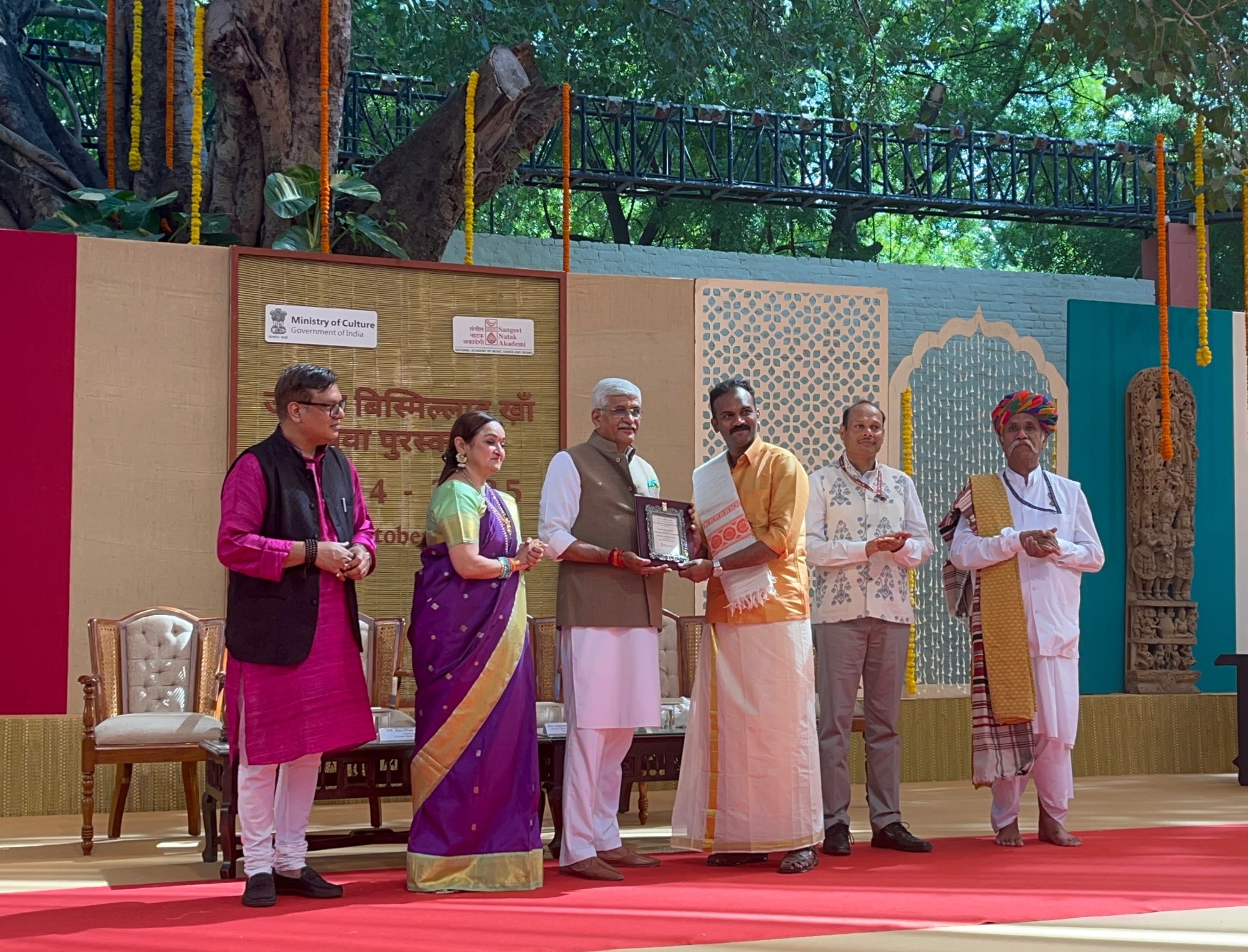
The award recognises Vipin’s individual achievement. It also brings attention to an art form sustained by years of practice, teaching and commitment across generations.
Is the Pulavar family the last family practising Tholpavakoothu?
The family of Koonathara is among the most important custodians of Kerala’s Tholpavakoothu tradition. The work of the late Krishnankutty Pulavar and succeeding generations helped take the art to audiences outside the temple while continuing its older repertoire.
You may encounter descriptions of the family as the last surviving hereditary practitioners. That wording requires qualification. Sources refer to different troupes, lineages and forms of practice, and it would be misleading to declare definitively that no other family practises the art in Kerala.
What can confidently be said is more substantial than a slogan: the Pulavar lineage has preserved demanding performance and puppet-making knowledge and has worked to train new artists while introducing the art to contemporary audiences.
Blackberry Hills: an incubation centre for Tholpavakoothu
Blackberry Hills is partnered with Vipin Viswanatha Pulavar and serves as an incubation centre for the art. Our aim is to provide opportunities for performance, learning and exchange, with the artist and tradition at the centre of the experience.
We organise Tholpavakoothu shows and workshops from time to time, and also explore sessions upon request. The format can be shaped around guests’ interests and the artist’s availability. Possible sessions include:
- Puppet-making workshops: An introduction to the forms, leather cutwork and techniques involved in making a shadow puppet, with the practical element adapted to the group.
- Traditional songs and recitation: Explore the verses, sounds and vocal rhythms that help carry the performance.
- Story workshops: Discover characters, episodes and the ways a narrative moves from spoken word to shadow theatre.
- Performances and demonstrations: Watch how the artists coordinate their movements, voices and light behind the screen.
These are not guaranteed daily activities. What can be arranged, how long a session lasts and any applicable charges will be confirmed for the particular enquiry. If this is an important part of your Munnar visit, please contact us before finalising your dates.
An offbeat thing to do in Munnar, and a different way to experience Kerala
Most Munnar itineraries are built around tea gardens, viewpoints, waterfalls and mountain walks. Those are good reasons to visit. But if you would like your journey to include a conversation with a living artistic tradition, a Tholpavakoothu performance or workshop offers something quite different. Instead of simply watching another scenic landscape, you get to understand how a story is turned into light, movement and sound by the people who know the craft.
It is an especially meaningful option for travellers looking for offbeat activities in Munnar, culturally curious couples, families interested in hands-on learning, or small groups who want an encounter with Kerala beyond a conventional sightseeing checklist. In a puppet-making or storytelling session, there is room to ask questions and appreciate the time and skill behind an object that may look deceptively simple on screen.
There is an important distinction, however. Tholpavakoothu is a traditional art form of Kerala, not an art form that originated in Munnar. Blackberry Hills brings visiting guests into contact with its practitioners through our partnership with Vipin. The resort’s role is to support learning and access, not to present the performance as a native Munnar ritual or as a show available every evening.
To include this experience in a Munnar itinerary, enquire in advance. Tell us your travel dates, the ages and number of participants, and whether you prefer a performance, a puppet-making introduction, a traditional song session or a storytelling workshop. We can then check the artist’s availability and discuss the format. For other experiences that complement a slower stay, visit our things to do in Munnar guide or the Munnar Trip Planner.
How to make the most of the experience
A little curiosity goes a long way. Ask how the puppet’s shape is chosen, how the same character can show different emotions, or how a performer learns such a long narrative. Children often connect immediately with the shadows, while adults may be fascinated by the craft and the way it brings together Kerala and Tamil literary traditions.
If you attend a temple performance, remember that it is a ritual setting rather than simply a tourist show. Respect the hosts’ instructions about photography, recording and movement. During a workshop, handle puppets only when invited to do so. They are carefully made performance objects.
Tholpavakoothu offers a different way to understand the region beyond its familiar tea estates and viewpoints. For more ideas, see our experiences in Munnar and the story of Blackberry Hills. Kerala Tourism also explains the art form’s traditional context.
Questions visitors often ask
What are some unique cultural things to do in Munnar?
If you are interested in going beyond viewpoints and tea gardens, consider a Tholpavakoothu performance or workshop arranged through Blackberry Hills. You can learn about Kerala’s shadow puppets, traditional storytelling or songs, subject to advance arrangement and artist availability.
Is a Tholpavakoothu performance held every day at Blackberry Hills?
No. We arrange performances and workshops occasionally and on request. Availability should be confirmed in advance.
Can children join a puppet-making or storytelling workshop?
Sessions can be discussed for families and younger visitors. Please share the participants’ age range and interests so the format can be considered with the artist.
Do I need to speak Malayalam or Tamil to enjoy a performance?
No. The movement, light and musicality are engaging on their own. If you would like more context, ask whether an explanation can be included when arranging the experience.
Can I request a private show or workshop?
You can enquire with your preferred dates and group size. We will check what may be possible; we do not promise a fixed price or guaranteed availability.
Experience the art of shadows
For an offbeat cultural addition to your Munnar trip, tell us whether you would like to watch a performance, explore puppet-making, or hear the stories behind the figures. We will explore the possibilities with Vipin and the team.