

Blackberry Hills Journal · Nature & Ecology
Shola Forests Around Munnar: A Guide to the Western Ghats’ Hidden Ecosystem
Discover the mountain forests and native grasslands that make Munnar’s high ranges extraordinary.
15 October 2026 · 8 min read
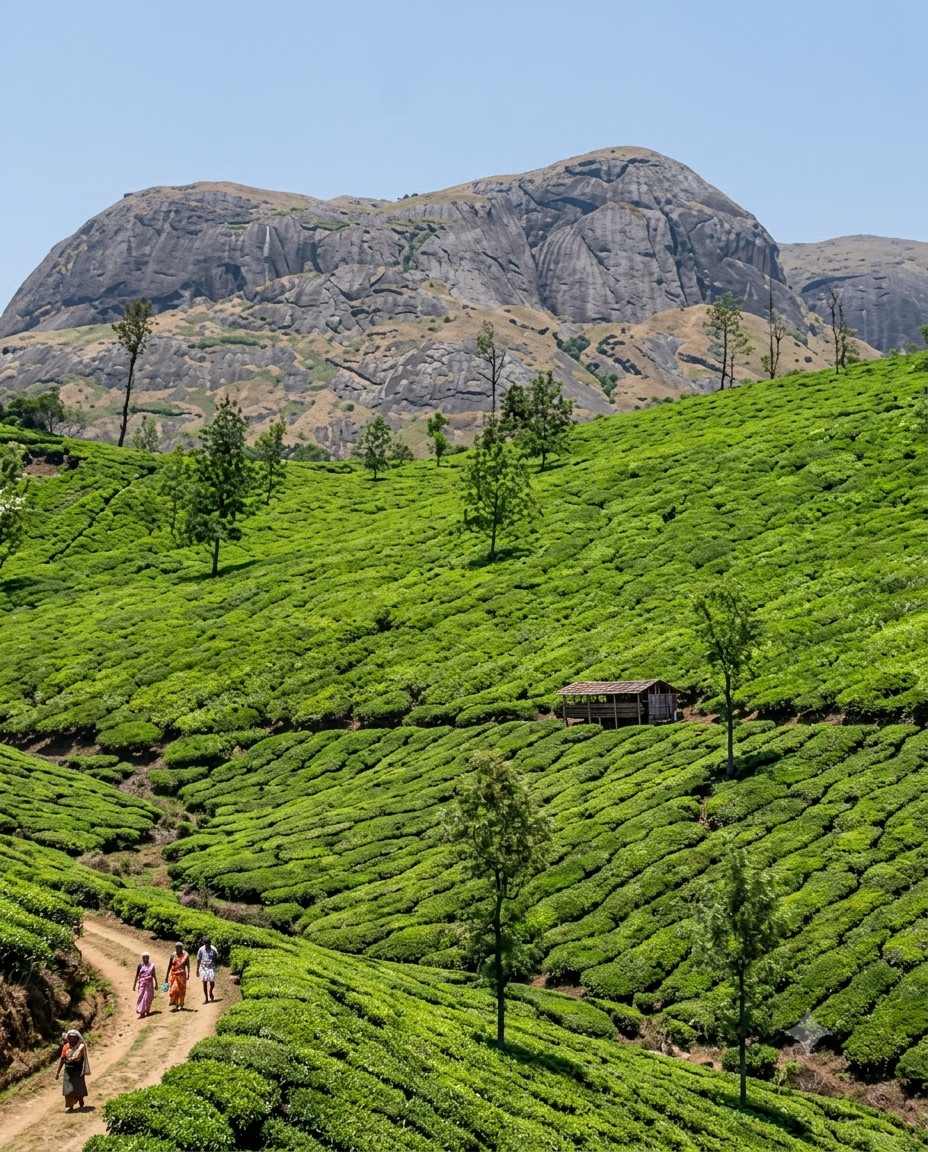
Look across Munnar’s high hills on a misty morning and you may notice something surprising. The slopes are not one continuous forest. Dark green pockets of trees gather in folds and valleys, while open grasslands sweep over the ridgelines. This living patchwork is the shola–grassland ecosystem, one of the most distinctive natural landscapes of the southern Western Ghats.
For travellers, the contrast is beautiful. For the plants, animals and streams that depend on it, the relationship between forest and grassland is essential. Understanding sholas changes the way you see Munnar: the hills become more than a scenic backdrop, revealing an intricate high-altitude habitat worth protecting.
What exactly is a shola forest?
A shola is a patch of tropical montane evergreen forest found in the higher elevations of the southern Western Ghats. Sholas commonly occupy sheltered valleys, hollows and folds of mountains, where their relatively compact, dense canopies form cool, shaded interiors. Neighbouring slopes and summits are often covered with native montane grasslands.
Scientists study the two habitats together because they form a forest–grassland mosaic, rather than a forest interrupted by empty land. The grassy areas have their own ecological communities and conservation value. They should not automatically be treated as degraded woodland waiting to be planted with trees.
In a shola, layers of vegetation create a different feeling from the exposed hillsides nearby. Mosses, ferns and other moisture-loving plants may thrive in damp, shaded places, while branches and leaf litter help make habitat for small creatures. At the forest edge, vegetation transitions rapidly into open country. That boundary is itself part of the ecosystem’s character.
Why the Munnar hills are special
Munnar lies among the high ranges of Kerala’s Western Ghats, a mountain landscape internationally recognised for exceptional biodiversity. Around the region, protected high-altitude habitats include the Eravikulam landscape and the shola areas associated with Pampadum Shola, Anamudi Shola and Mathikettan Shola national parks.
Altitude, exposure, moisture, soil and the long ecological history of these hills help shape where different plant communities grow. An open grassy ridge and a sheltered forest hollow may stand close together, yet offer markedly different conditions to wildlife.
It is easy to focus on tea estates when thinking of Munnar. The plantations are culturally and visually important, but they are not the same as native shola forest or montane grassland. Learning to distinguish these landscapes is a wonderful first step toward a richer visit. For more ideas beyond the familiar circuit, see our guide to hidden places in Munnar.
A small forest with a big role in water
Sholas are closely linked to the high ranges’ water systems. Mountain rain and mist, vegetation, soil and the surrounding grasslands interact to store and move moisture through a landscape. Research identifies shola forests as important to watershed functioning and the streams associated with these uplands.
The benefits are not limited to what visitors can see. Healthy vegetation and soils help regulate how water travels downslope; the forest floor also provides a home for organisms that break down leaf litter and recycle nutrients. These relationships are complex, and no single forest patch can be credited with producing a fixed volume of water.
On a nature walk, notice how the environment changes as you approach a wooded hollow. The light becomes softer, the air may feel cooler and the ground may hold more moisture. Observing these changes without stepping off the trail is one of the simplest ways to appreciate how the mosaic works.
Wildlife: from open slopes to shaded canopies
The wider Munnar highlands support a varied community of mammals, birds, reptiles, amphibians and invertebrates. The endangered Nilgiri tahr is especially associated with the open, rocky highlands of Eravikulam. It is an emblem of the region’s mountain ecology, but it is not a forest-dwelling animal to expect inside every shola.
In the forested parts of the wider landscape, animals such as the Nilgiri langur, alongside specialised birds and smaller creatures, depend on native habitat. Some species are difficult to spot; others are best detected by calls, tracks or fleeting movement. Species distributions vary among parks, elevations and seasons, so a visit is never a wildlife-sighting guarantee.
The most rewarding approach is to slow down. Listen before talking, watch tree crowns without disturbing them and enjoy the details: moss-covered branches, insects moving through leaves, and the contrast between bird sounds on the open slope and at the forest edge. Our Munnar wildlife guide offers more context for nature-focused outings.
Where can you experience shola landscapes near Munnar?
Eravikulam National Park
Eravikulam is one of the best-known places to understand the visual relationship between sweeping high-altitude grasslands and forest patches. The authorised visitor area at Rajamalai offers an introduction to this protected landscape and the Nilgiri tahr. Access is regulated, with visitors confined to designated areas; private exploration of the wider national park is not permitted. The park is typically closed during the tahr calving season in February and March, so check official information before planning your day.
Pampadum Shola National Park
Near the Vattavada side of the Munnar region, Pampadum Shola protects an important mountain forest landscape. Kerala’s Forest Department describes approved trekking and ecotourism opportunities here. These are managed activities, not an invitation to wander into protected forest independently. Confirm the current programme, required permissions, route and weather conditions with the Forest Department.
Other protected shola habitats
Anamudi Shola and Mathikettan Shola national parks are further reminders that the Munnar region’s natural heritage extends well beyond any single viewpoint. Their protected status does not imply that every section is open for casual tourism. Seek current, official visitor guidance rather than following an unverified map pin or informal trail suggestion.
For a broader mix of scenery and quiet destinations, browse our guide to Bison Valley and the surrounding hills.
How to explore respectfully
Fragile montane habitats are vulnerable to trampling, litter and unregulated access. A thoughtful visit helps protect the same atmosphere that makes these mountains memorable.
- Choose authorised routes: use designated viewpoints and Forest Department-approved walks, with permits or guides when required.
- Keep plants where they grow: do not pick flowers, collect moss, remove soil or wander into vegetation for photographs.
- Give wildlife space: never feed or approach animals, and keep noise low.
- Carry waste out: follow each protected area’s rules on food, disposable materials and plastics.
- Prepare for mountain weather: take suitable walking shoes, rain protection and a warm layer; mist and rain can change conditions quickly.
- Respect closures: access restrictions may protect breeding wildlife, habitats or visitor safety.
The best nature experiences rarely involve trying to cover the greatest distance. A short permitted walk, taken attentively, can reveal more than a rushed trip through several sensitive locations.
When should you visit?
Different seasons show different sides of the high ranges. After rainy periods, vegetation can appear especially lush, while trails may be slippery and leeches more noticeable. Clearer-weather days may offer wider views of the forest–grassland pattern. Mist is part of the mountain experience, but it can quickly obscure viewpoints.
Rather than relying on a single “best” month, plan around the specific protected area, current weather, available guided activities and seasonal closures. Check park notices near your travel date. If you are still arranging the journey, our guide to reaching Munnar can help with the wider trip.
Experience Munnar as more than a view
A landscape becomes unforgettable when you begin to understand what you are looking at. The rounded grasslands are not bare hills, the dark forest patches are not random clumps of trees, and the quiet hollows are part of a connected mountain system. Each has a role in supporting life.
Blackberry Hills celebrates slower, nature-led ways to encounter Munnar. Our guide to nature experiences at Blackberry Hills describes the resort’s Shola Forest Trek among its offered activities; ask the team about current availability, route details and any necessary permissions before making plans. The aim is not simply to reach a destination, but to return with a more attentive relationship to the Western Ghats.
Frequently asked questions
What is the difference between a shola forest and a tea plantation?
A shola is a naturally occurring high-altitude evergreen forest habitat. A tea plantation is a managed agricultural landscape. Both may look green from a distance, but they differ in structure, species and ecological function.
Why are grasslands found next to shola forests?
Sholas and montane grasslands form a long-established ecological mosaic shaped by the conditions and history of the mountains. The native grasslands are valuable habitats in their own right, not necessarily cleared forests.
Can tourists walk inside shola forests near Munnar?
Only where the relevant authorities permit it. Some protected areas provide approved walks or guided ecotourism, while other sections are restricted. Confirm access and permits before travelling.
Where can I see the shola–grassland landscape?
Eravikulam’s designated Rajamalai visitor zone is a well-known place to appreciate high-altitude grasslands and neighbouring forest patches. Pampadum Shola also has Forest Department-managed nature activities, subject to current rules.
Will I see a Nilgiri tahr in a shola forest?
Nilgiri tahr are associated mainly with open rocky slopes and montane grasslands rather than dense shola interiors. Wildlife sightings are never guaranteed.
Are shola forests important for water conservation?
Yes. Scientific research recognises shola forests and their associated upland habitats as significant parts of Western Ghats watersheds, helping sustain natural water systems.